“GESI ni maisha yangu.”
Literally meaning “GESI is part of my life,” the simple statement resonated strongly across the room. But what does it take for Gender Equality and Social Inclusion (GESI) to become more than a policy or project commitment to shape how organisations work, how communities participate, and how decisions are made?
What happens when an organisation stops asking, “Do we have a GESI policy?” and starts asking, “How is that commitment changing the way we plan, budget, collect data, engage communities and make decisions?”
These questions shaped the GESI component of the SAUTI ZETU Initiative during the Horizontal Learning Meeting held in Dodoma from 28–30 September 2026. The meeting brought together members of the SAUTI ZETU Alliance to reflect on what they have learned, what is changing within their organisations and programmes, and what it will take to sustain these changes beyond the project.
Coordinated by HakiElimu, the SAUTI ZETU Initiative works through partnerships among civil society organisations, government and communities to strengthen transparency, responsiveness and accountability in education. Within this work, GESI is not a stand-alone agenda. It is about ensuring that the systems and mechanisms through which people participate and demand accountability respond to different realities, needs and barriers.
The meeting built on a GESI audit conducted across the Alliance. Rather than treating the audit as an assessment whose findings would simply be filed away, HakiElimu used it as a starting point for reflection, peer learning and action. The important question was not only what the audit found, but what organisations are doing with what they learned.
When GESI Starts Changing Everyday Practice
For some Alliance members, the shift is already visible in the small but important decisions that shape programme implementation.
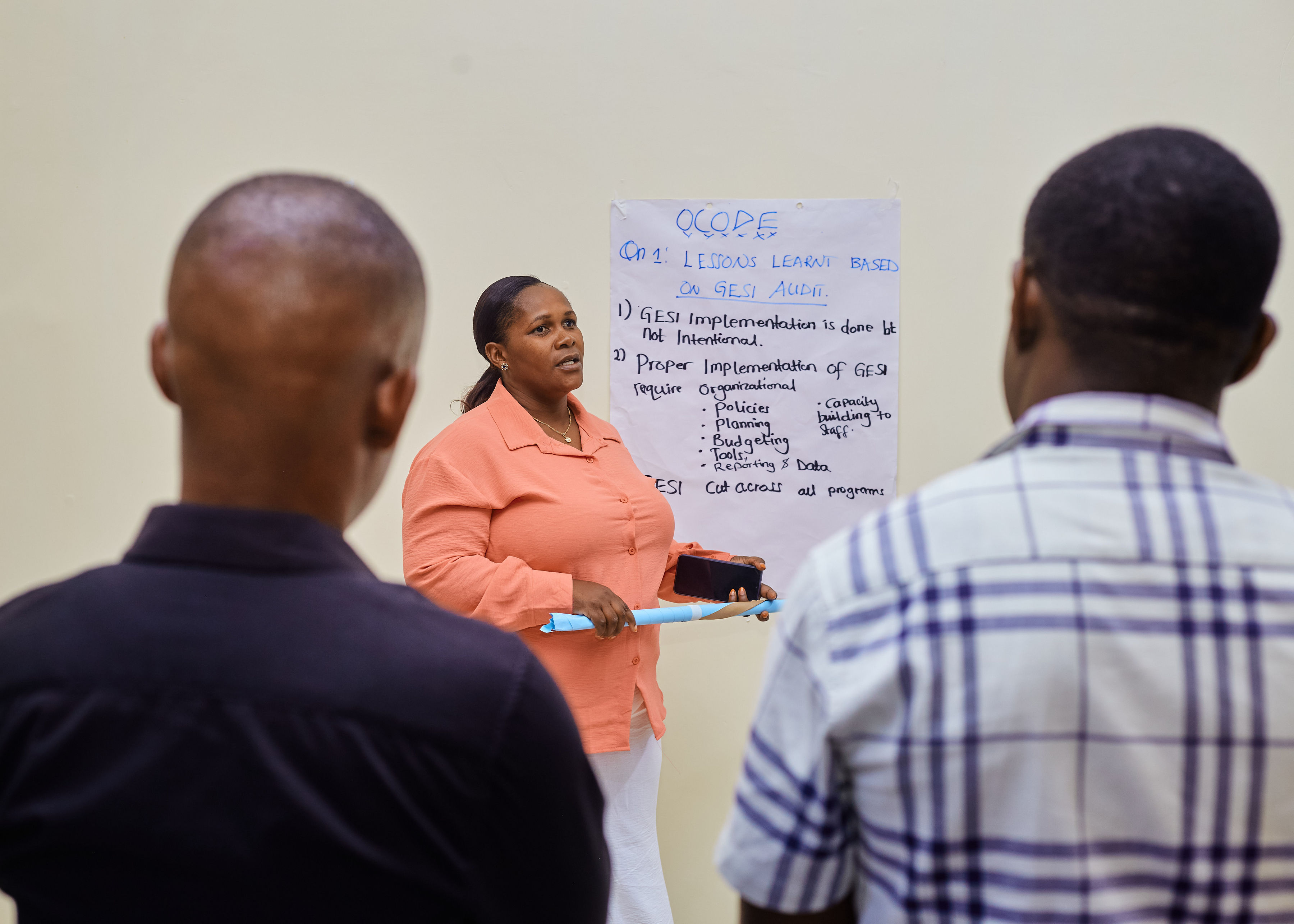
OCODE reflected on how GESI learning has changed the way it thinks about participation. Previously, inviting parents, teachers or school committees to a meeting could be considered sufficient. The reflection is now more intentional: Who is actually in the room? Who may face barriers to participating? Is the venue accessible? Whose voice might still be missing?
This thinking is also influencing practical decisions, including the selection of venues that can be accessed by people using wheelchairs and the review of data collection tools to better capture the experiences of people with disabilities and others facing barriers to inclusion.
“The GESI learning has helped us become more intentional about inclusion. We are paying greater attention to women, children, people with special needs and other marginalized groups, creating more space for them to participate and speak up. We are now seeing their voices being heard, and their input helping to inform decisions about the work we implement in their communities.” Said a representative from OCODE.
These may appear to be operational details, but they point to a deeper institutional shift. GESI becomes meaningful when it begins to influence the everyday decisions that determine who participate, whose experiences are visible in data, and whose needs are considered in planning and resource allocation.
From Being Heard to Having Influence
But inclusion cannot stop at participation.
A more difficult question is: When people are invited to speak, what changes because they spoke?
Across the Alliance, partners are experimenting with different ways of strengthening the link between community voice and action.
OCODE, for example, has created opportunities for people with disabilities to participate in project oversight and monitoring, while community engagement and media platforms have created spaces for parents and community members to share their experiences and concerns related to inclusive education.
Other Alliance members are approaching this from different angles. SAWA is strengthening school-community accountability and creating mechanisms through which children, parents and teachers can raise concerns and follow up on children’s wellbeing and progress. SEFDF is linking social accountability monitoring with evidence-based advocacy, while MTWANGONET has connected disability-focused advocacy with engagement at council level. CST has taken this pathway further through strategic engagement with Members of Parliament:
“One of the outcomes of our engagement with MPs was seeing the issues we discussed raised during the education budget debate in Parliament. The Minister acknowledged them, and our contributions were recorded in the Hansard. For us, that was a significant impact.”
CST representative
These experiences point to the same principle: participation should have a pathway to influence. This means moving beyond collecting community concerns to ensuring that those concerns can inform decisions, budgets and implementation, and that communities can see what changed as a result.
A representative from MTWANGONET reflected on how advocacy is increasingly translating into action at council level:
“Through our advocacy, we have seen greater attention to disability and inclusion at council level. We are using evidence from communities to engage local government and influence planning and budgeting, so that the needs and voices of women, young people, people with disabilities and other marginalized groups are increasingly reflected in decisions and resource allocation.”
These approaches are different, but they point to the same principle: participation should have a pathway to influence.
That means moving beyond collecting community concerns to ensuring that those concerns can inform decisions, budgets and implementation, and that communities can see what happened afterwards.
Learning Across Organisations, Not Simply Copying Practices
One of the strongest values of the horizontal learning approach was that there was no expectation that one organisation had the perfect model for others to copy.
Instead, the Alliance brought different experiences to the same table.
OCODE shared its experience with second-chance and vocational pathways for young people. SAWA brought learning on school-community accountability and learner feedback. SEFDF demonstrated how monitoring can generate evidence for advocacy. MTWANGONET highlighted disability-focused advocacy and engagement with local government, while CST shared experience in strengthening disability-centred systems and stakeholder-led inclusion.
The value was not simply in showcasing what each organisation does, but in understanding what makes a practice work, what conditions are required, and how it might be adapted to another context.
This is important because institutional change rarely happens through a single intervention. It is built through connected changes in planning, policies, budgeting, staff capacity, tools, data, implementation and follow-up.
The Real Test Is What Lasts
Perhaps the hardest part of GESI work is sustaining change.
A policy can be approved and still remain largely unused. A commitment can be made without the resources needed to implement it. Data can be collected without being used to identify who is being excluded. And participation can happen without people having meaningful influence over decisions.
The Alliance reflections therefore pointed to the importance of embedding GESI within organizational systems rather than leaving it with one person, one project or one training session.
This includes reviewing policies, strengthening staff capacity, improving data systems, allocating resources for meaningful inclusion, and building follow-up into everyday practice.
This is where the conversation moves beyond organizational change to community impact. Stronger internal systems matter because they create the conditions for communities to participate more meaningfully, for excluded groups to be heard, and for accountability mechanisms to respond to the realities people experience.
“GESI ni Maisha Yangu”
Perhaps the simplest expression of this broader understanding came unexpectedly during the meeting.
A representative from MTWANGONET said: “GESI ni maisha yangu.”
The phrase immediately resonated with participants and received strong support across the room. It was not a pre-planned campaign slogan. It emerged naturally from the reflection.
And perhaps that is what made it so powerful.
If GESI is understood only as a policy, checklist or project requirement, it can easily become something organisations simply comply with. But when it becomes part of how people understand their work, their institutions and their communities, it has a greater chance of becoming everyday practice.
The next shift requires sustained attention to power, institutional routines, meaningful influence and accountability. For the SAUTI ZETU Alliance, this means continuing to strengthen the systems, practices and relationships that allow GESI to move from commitment to everyday practice and from participation to meaningful influence in decisions that affect people’s lives.
Because lasting change is not only about what a project delivers. It is about what people and institutions are able and committed to carry forward, so that progress continues beyond the project cycle.